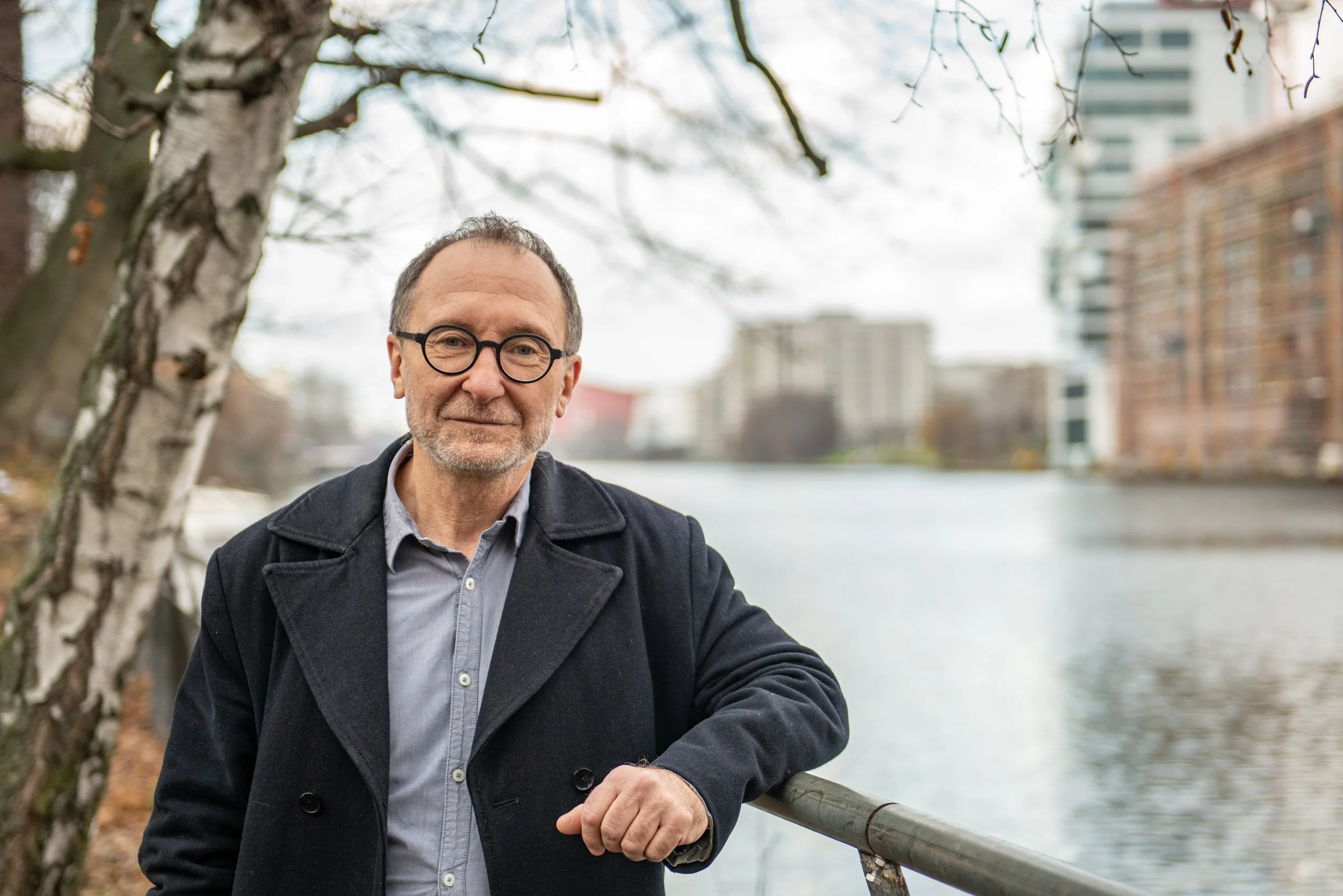
Timothy Florence is a composer, keyboard player and music-pedagogue in Berlin and Brandenburg, Germany.
Timothy Florence has been living and working as a composer and musician in Berlin, Germany for over thirty years.
He is originally from Australia, and was born in 1960 in the city of Brisbane, where he also grew up. He took up piano lessons at 7, violin lessons at 8. Several years later he also started playing the organ through his local Anglican parish church, and from the age of 16 till he was 22 was the regular organist for Sunday church services - an activity resumed some 37 years later in the couple of village churches belonging to the (established Lutheran) Brandenburg parish outside Berlin which he often visits. He came to keyboard improvisation at around 10 and this has remained a central part of his musical life, feeding the written compositional activity. Perhaps the organ was the catalyst there. Tim Florence studied composition and piano at the Queensland Conservatorium of Music, composition under Carl Vine, and graduated at the end of 1982.
In December 1990 he visited Berlin, staying on then till the present time. Stimulation to come and in fact stay, came from several different directions, not least the descriptions and encouragement of an Australian musical couple – old friends since student days, who had been living in West Berlin for much of the 1980s. In addition to this influence came the impressions of the remarkable developments during the year of 1989, as well as the composer’s old and intense interest in German history and German music history and their relationship to European cultural and political history in general. Once arrived the spark was ignited, and the decision to remain in Berlin was soon taken.
Florence has composed for a variety of constellations over the years, from solo pieces to orchestra. In 2000, together with composer friend Georgios Syfridis and other musician and composer colleagues he founded an ensemble centered around new compositions called Cornucopia. The group had twelve constant members through its fifteen years of existence and its aim was to convincingly combine in performances a substantial proportion of new compositions building on a broadly tonal basis (although by no means exclusively) and traditional music/music influences of various cultures with different “experimental” approaches, often in a theatrical-spatial setting. For Cornucopia he wrote numerous works for many larger projects. ‘Into my Heart’ (2008, to be found in the listening section of this website) was written for one of the larger projects, a kind of music-theatre whole called “Babylon”, initiated, produced, and directed by Jens-Uwe Sprengel for T-Werk Potsdam in October 2008.
Not long before the founding of Cornucopia in Berlin the ensemble Topology based in Brisbane commissioned in 1998 a new work through the Australia Council from Tim Florence. Topology had been founded by composer and contrabassist Rob Davidson together with Bernard Hoey, Kylie Davidson, Christa Powell and John Babbage a few years before. (Topology grew out of the remarkable Music for the Heart and Mind concert series/creative collective/movement founded in Brisbane in the early 1990s by the musicians mentioned above together with composer-performers Lynette Lancini, Tom Adeney and Roland Adeney.) His new work for Topology first intended to be a work of about 10 -15 minutes turned into something significantly larger, with a single central idea - a famous chorale of Bach’s (Jesus bleibt meine Freude) - expanded over a large stretch of time, also across a series of interludes - a kind of vast chorale prelude of about 60 minutes duration. Bach’s chorales and chorale settings have played a central role in Florence’s musical imagination.’Chorales’ come in many pieces of his, sometimes as pre-existing melody, often in fact completely composed, directly influenced by the defining format of those earlier centuries. The first part or movement was first performed by Topology in Brisbane in 2000, the final part/movement in 2004 in Brisbane. (The first and third movements can be found in the listening section of this website.)
,
In the last two decades he has been particularly fascinated and profoundly influenced by partner Petra Priess’ ensemble activities in the field of „early music“,( i.e. medieval, Renaissance and Baroque periods), with particular emphasis on late medieval (14th century) and early Renaissance (15th century) works. This fascination has flown into works written for her ensemble, Ensemble Orlando Potsdam. Along with more regular concerts Orlando Potsdam has also, like Cornucopia produced to date a number of specially conceived theatrical-concerts. These have been conceptually initiated by the founder of the ensemble, Juliane Maria Esselbach, sometimes in this role in collaboration with Petra Prieß. Juliane Maria Esselbach also leads a youth choir in Potsdam connected to the beautiful Friedenskirche in Sans-Souci, the Versailles-like ‘palace park’ of the Hohenzollern kings - later German Kaisers - established by Frederick the Great (1712 - 1786). Florence has been commissioned through Esselbach to produce the music for several large projects. Probably the most ambitious of these was the work ‘Franziskus ‘ (premiered in July, 2016) on the life of Francis von Assisi (1181? - 1226). It involved both the young choir members as singers and actors and Orlando Potsdam in the instrumental/accompanying function under the music and theatrical direction of Juliane Maria Esselbach, who was also responsible for the text. Tim Florence provided all the music with the exception of a medieval dance; his musical contribution is freely oriented towards medieval styles combined with modern elements filtered through his own perspective. The work has been performed again in several places in Germany.
Another of the larger projects commissioned by Juliane Maria Esselbach (there have also been many single pieces commissioned for Ensemble Orlando alone…) involved the setting of a series of small Haiku-like poems by Hermann Hesse (1877 - 1962) describing each month of the year, ‘Der Jahreskreis’. This was then realized also theatrically by Juliane and her youth choir. The ‘staged’ performance took place in October 2022, in the Friedenskirche of Sans-Souci in Potsdam. The cycle was practically conceived by the composer also as a song cycle for high voice and piano which could be performed in other contexts later, and was first performed as such by Juliane Maria Esselbach and pianist daughter Aglaja Sprengel in the central Oberkirche church of Cottbus in August 2022.
Ensemble Orlando has also produced two elaborately staged Wandelkonzert-seasons in the unique Kulturspeicher, a former grain silo built on the edge of the village of Gramzow in the Uckermark in 1954, and transformed by a group of expert enthusiasts into a cultural venue.The two seasons were in August 2021 and August 2022. Each concert deployed all 8 stories of the building in a movement starting at the top and proceeding gradually to the bottom of the building. Florence wrote a new work for each season. His piece ‘Die Taube’ setting a short poem of Ingeborg Bachmann’s (1926 - 1973) along with some verses in Latin from Psalm 23, was written for the 2021 season (and can be heard and viewed in the video in the listening section of the website.)
Further works for Orlando and Esselbach include a ‘De Profundis’ setting (2011-for 3 solo singers, string/gamba quartet, and positive organ) for the Good Friday service in 2011 in the old Marienkirche of Beeskow, south-east of Berlin, commissioned through its cantor Matthias Alward. The Friedenskirche churchparish commissioned a work from Tim Florence as well, with Orlando and guest singers for a special Easter Monday service in 2015 devoted to the plight of refugees. The work is called ‘Der Augenblick’ and takes a poem by German Baroque poet Andreas Gryphius (1616 - 1664), concerned with the transitoriness of things earthly and seizing, in response, ‘the moment’ to experience the presence of God. Gryphius lived and wrote during the long terror and destruction of the Thirty Years War (1618 - 1648) which brutalized and laid waste no land, no culture, more than Germany, and whereby it is not difficult to imagine why a sense of futility in all larger earthly designs could have taken hold at that time for the more sensitive. This was a cataclysmic event which many scholars now believe decisively shaped the development of certain prominent/difficult aspects of the German mentality in the centuries to come.
Going on to Germany’s other cataclysmic event, the National Socialist period and the Second War, and to a cataclysmic event during that period in one small family: in the years before the War, Jochen Klepper (1903 - 1942) a theologian, had also become a well-known journalist, novelist and poet. He wrote many striking poems of devotion, quite a few of which have found their ways as hymn texts into the main Lutheran hymn book. In 2017 Orlando commissioned settings of Klepper’s religious poems, as a special tribute to Klepper, also in the context of the following background:
Klepper had married a Jewish widow, Johanna Stein (nee Gurstel) in 1931 and she then after a time converted to Christianity. Nevertheless under the National Socialists (from January 1933) he was still under pressure to leave her and his step-daughters, and the fact that he refused to leave eventually led during the war years to him and his family being more and more excluded from many public aspects of social life, with the deportation of his wife and daughters all the time becoming more threatening. He and his family decided the only way out was to take their lives together, and they did so on the night of the 10th December 1942; strikingly enough with full faith in God that they were taking the right path under the extreme circumstances. The poem settings became part of a musical-semi-theatrical tribute commissioned from Orlando by the parish church which Klepper and his wife had regularly attended up to their deaths. The church is in the south-west Berlin neighborhood(Nikolassee) of the house where Klepper and his family lived - and died. (On their former regular church pew is now a plaque in memory of them.)
Two recording projects with Orlando might be mentioned here too. The first is a Christmas album, with mostly pre-Baroque music to do with that feast, in addition two new pieces with a connection to the ancient and the theme Christmas were commissioned. That by Tim Florence is called This Endris Night, and sets anew a 15th century English Christmas-Lullaby text of that name. (Two sopranos, violin, harpsichord and organ.) The other by Georgios Syfridis took up an old Greek Christmas melody and text. The album appeared in early 2013.
In the following year, 2014, another album was put together and recorded by Orlando, this time focused on German lullabies and traditional or older art songs to do with the evening, sleep and the night. Tim Florence arranged all the traditional or folk-like melodies, including, ‘Der Mond ist Aufgegangen’, ‘Der Liebe Mond’ (or ‘Nacht und Still’), ‘Wer Hat die Schönsten Schäfchen?’ und ‘Abend Wird es Wieder’.
In the last twenty years Florence has also written orchestral and music theatre works, Gebrauchsmusik, for the special pedagogical requirements and conditions of his municipal music school in Berlin-Spandau - where he teaches piano - including a lengthy symphonic poem commissioned by the music school, “Das Leben des Carl Schurz” (2018) for an enlarged music school orchestra based on the early life of Carl Schurz (1829 - 1906). Schurz was a fascinating political figure, also passionate about music, connected with Spandau and gained enduring renown in Germany due to a daring act of political-prisoner- liberation in the time just after the suppression of the 1848 uprisings.
Among the special projects for the Musikschule Spandau over the years have been the regular series of music theatre productions affectionally known as the “Nikolausmärchen," on and around the 6th December (St.Nicholas’ Day) each year in the Spandau Zitadelle, a 16th century fortress complex on the edge of the Altstadt of Spandau. A range of traditional folk tales (including Grimms’) and Kunstmärchen (author-known folk-tale-like stories.) have been turned into scripts by Petra Prieß and produced as plays on stage with a lot of music from the music school orchestra sitting below the stage made up of mostly children and teenagers with a few adults. Usually at least two-thirds of the music is especially composed each time, with the task shared between two in the last few years. The rest of the music is selected form a variety of sources. The whole has become a positively collective undertaking.
Tim Florence has written the complete music for two of these productions, Der Rattenfänger vonHameln (‘The Pied Piper of Hameln’) in 2011, and Linkschuh und die Meermurmel ‘(Left Shoe and the Foundling’) in 2016. The former is an old German saga, anonymous, (unusually it actually has a date and a place as part of the story, i.e. Hameln in 1284, but of course no author) taken up by the brothers Grimm in their famous collection.
The latter is a story written by Australian children’s author, Annie O’Dowd.Left Shoe and the Foundling is part of a delightful series about a settlement of mythical small creatures called Seadogs, who live in burrows by the sea around their own sandy cove, Foamy Bay. (This setting was inspired by the author’s childhood holidays on South Stradbroke Island). Annie adapted the story into a script, which was edited and translated into German by Petra Prieß. As the literal translation for “Seadogs” in German, “Seehunde”, already refers to seals, Petra Prieß decided to take the first part of the German word for groundhog, (“Murmeltier”) and combine that with the word for sea (“Meer”), thus “Meermurmel”; the protagonist, Left Shoe became Linkschuh. Linkschuh und die Meermurmel was produced in four performances over two days on the 6th and 7th December, 2016, and at a later season during the summer of 2017. Tim Florence and Annie O’Dowd plan to turn this story into a children’s opera: a significant conceptual extension of the original concert with scenes version in Berlin. Annie O’Dowd has undertaken doctoral research on the challenges of adapting this story into a libretto for the project. Recently the collaboration has extended to the inclusion of young Australian composer and singer Emily Malczwewski to work closely with them in an unusual two-composer project…
A description of Florence’s creative musical life over the years would not be complete without discussing something of his activities as a keyboard improviser, touched on briefly at the beginning. Improvising has always been a private nurturing ground for composition, but numerous appearances have taken place over the years. This was always alone in the earlier years but in more recent years also undertaken together with other musicians. Co-operative endeavors were stimulated by working together with performing vocalist and singer Theda Weber-Lucks from 2000 on; especially with the collaborative and semi-improvised work, ‚Irrungen und Wirrungen des Herzens’ first performed in July 2000 in the Theodor-Heuss-Saal of Rathaus Berlin-Schöneberg. This was commissioned by the Leo -Kestenberg -MusikschuleTempelhof-Schöneberg; Dr. Theda Weber-Lucks is also an expert for the exploration of extended vocal techniques, both as a performer and academically, having undertaken her doctoral research in this field. She is head of the department for contemporary music in the Leo-Kestenberg-Musikschule Tempelhof-Schöneberg. Numerous other collaborations through the Leo-Kestenberg-Musikschule (LKMS) have followed.
Highlights have been for instance the space-sound-performance event (2018) to ‘critically commemorate’ the 80th anniversary of the building of Rathaus Tempelhof. The building was erected by the National Socialists. Music and performance was present in many rooms simultaneously; Tim Florence led a group of improvisers on the higher level of the entrance hall against the sonic background of a processed Wagner recording; also later in a trio with piano, saxophone and soprano in the exhibition hall.
Another notable large project (conceived by Weber-Lucks with creative assistance from Tim Florence) was the conceptual and semi-improvised ’Oper am Hirschbrunnen’ (2021 ) performed in the landscaped park near Rathaus Schöneberg This park had been laid out in the spirit of the early German Romantic and is dominated by a fountain with a large golden deer statue at its center. This work was a collage-opera for 6 improvising soloists, with a solo opera singer a male choir and a horn quartet. The project was commissioned through Leo-Kestenberg-Musikschule for the Draussenstadt (Outside City) series initiated and funded by the Berlin Senate in response to Covid restrictions.
The most recent project with Theda Weber-Lucks and the LKMS was ‚No Borders in Sight’ premiered in June 2025 in the spaces surrounding the old Control Tower area of the former and historic Tempelhof Airport in the middle of Berlin. Again a site laden with historic associations and the colossal Nazi architecture of Albert Speer. It was a big site-specific event consisting of three parts; Tim Florence was commissioned by Weber-Lucks via Draussenstadt und LKMS as part of her overall conception to compose the final section of the second part in the entrance hall. This section was imagined like the spaceship journey of the last human survivors in a dystopian vision fulfilling the scientific prognosis of cosmic entropy using organ , two double basses, saxophone and percussion. Starting with sustained organ pedals, motives from Wagner’s Siegfried were used in a build up climaxing in a very wild saxophone solo, leaving a fifth drone sounding on into infinity.
Florence is also a member of a Berlin free improvisation trio, Lilly along with vocalist Ulla Weber, and multiple wind instrument player Dietmar Herriger. They do several concerts a year. He also shares his long years of experience in free improvisation and the possible applications in music making with children in the teaching situation in workshops for music teachers. (January 2026, “practice in flow” for the VdMK Brandenburg - Federation of Music and Art Schools Brandenburg).
In April 2023 Dr. Weber-Lucks organized as head of the faculty for contemporary music in the LKMS, andunder the auspices of the music school, a composer-portait concert celebrating the music of Timothy Florence in the central central concert hall of the LKMS in the Haus-am-Kleistpark in Schöneberg. Weber-Lucks participated as a host, interviewer and performer and was joined by Petra Prieß, Juliane Maria Esselbach, Aglaja Sprengel, Ulla Weber und Dietmar Herriger in the course of the evening.
2024 brought amongst other events, a commission to perform and compose for the opening event of the AMAZE congress for alternative new computer games. This was held in a remarkable setting - an old crematorium in inner Berlin (Wedding) since turned into a performance and conference centre. Petra Prieß and Timothy Florence performed as a duo with violin, e-church organ, bells and synthesizer. The new piece from Florence - also chorale -centred - was then christened Amaze.
In October 2025 Tim Florence (organ and piano). Petra Prieß (violin) and Katrin Albrecht (Cello) performed as a trio in a concert as part of a church series in Prenzlau, in Church of St. Sabine,(St.-Sabinenkirche) one of several striking medieval churches in Prenzlau, with a striking Renaissance altar and beautifully restored organ. Florence completed a new piece - !chorale-based - developed out of two semi-improvisations performed in the earlier part of the year in different Uckermark churches for Lenten meditation services organized by the church’s ‘Commissioner for Adult Faith’ for the Uckermark, Holger Müller-Brandes. The new piece is called ‘Vergebung’, (‘Forgiveness).
Recently completed is a “Fantasia Concertante” for 3 soloists: oboe, violin and harpsichord, with Baroque string orchestra written for violinist Bernhard Forck and the renowned Akademie für Alte Musik Berlin (“AKAMUS”). This will be premiered in the near future in Berlin.
Over the years his works have been performed in Australia, Germany, Italy and Greece.
FOR FLORENCE’S REFLECTIONS ON MUSIC AND ITS RELATION TO LIFE, PLEASE SEE HIS BLOG ON THIS WEBSITE! First, the essay, ‘A Philosophy of Music?’
About
Über
Timothy Florence lebt und arbeitet seit über dreißig Jahren als Komponist und Musiker in Berlin. Er stammt ursprünglich aus Australien und wurde 1960 in Brisbane geboren, wo er auch aufwuchs. Mit sieben Jahren begann er Klavier zu spielen, mit acht Jahren Geige. Einige Jahre später begann er mit dem Orgelspiel in seiner anglikanischen Pfarrkirche und war von seinem 16. bis zu seinem 22. Lebensjahr regelmäßiger Organist im Sonntagsgottesdienst – eine Tätigkeit, die er rund 37 Jahre später in den evangelischen Dorfkirchen in der Uckermark nahe Berlin wieder aufnahm, wo sich oft aufhält.
Mit etwa zehn Jahren begann er, auf dem Klavier zu improvisieren, und dies ist bis heute ein zentraler Bestandteil seines musikalischen Lebens und prägt sein kompositorisches Schaffen. Die Orgel war dafür wohl das auslösende Moment.
Tim Florence studierte Komposition und Klavier am Queensland Conservatorium of Music, Komposition bei Carl Vine, und schloss sein Studium Ende 1982 ab.
Im Dezember 1990 besuchte er Berlin und blieb seitdem dort. Die Anregungen zu seiner Reise und seinem Aufenthalt kamen aus verschiedenen Richtungen, besonders aber durch die Erzählungen und die Ermutigung eines australischen Musikerpaares – alte Freunde aus Studienzeiten, die einen Großteil der 1980er Jahre in West-Berlin gelebt hatten. Hinzu kamen die Eindrücke der bemerkenswerten Entwicklungen des Jahres 1989 sowie das langjährige und intensive Interesse des Komponisten an der deutschen Geschichte und Musikgeschichte sowie deren Bezüge zur europäischen Kultur- und Politikgeschichte im Allgemeinen. Nach seiner Ankunft war der Funke übergesprungen, und die Entscheidung, in Berlin zu bleiben, fiel bald.
Florence komponierte im Laufe der Jahre für verschiedenste Besetzungen, von Solostücken bis hin zu Orchesterwerken. Im Jahr 2000 gründete er zusammen mit befreundeten Musikern und Komponisten das Ensemble „Cornucopia“, das sich auf neue Kompositionen konzentrierte. Die Gruppe bestand während ihres fünfzehnjährigen Bestehens aus zwölf festen Mitgliedern und verfolgte das Ziel, in ihren Aufführungen einen hohen Anteil neuer Kompositionen auf einer breiten tonalen Grundlage - wenn auch nicht ausschließlich - mit traditionellen Musikeinflüssen verschiedener Kulturen und experimentellen Ansätzen zu verbinden, oft in einem theatralisch-räumlichen Kontext. Für „Cornucopia“ schrieb er zahlreiche Werke.
In den letzten zwei Jahrzehnten war er besonders fasziniert und tief beeinflusst von den Ensembleaktivitäten seiner Partnerin Petra Prieß im Bereich der Alten Musik - Mittelalter, Renaissance und Barock -, mit besonderem Fokus auf Spätmittelalter und Frührenaissance. Diese Faszination floss in die Werke ein, die er für ihr Ensemble (Orlando Potsdam) komponierte.
In den letzten zwanzig Jahren schrieb er auch Orchester- und Musiktheaterwerke, speziell für die pädagogischen Anforderungen und Gegebenheiten seiner städtischen Musikschule in Berlin-Spandau, in der er Klavier unterrichtet. Darunter auch die von der Musikschule in Auftrag gegebene, umfangreiche sinfonische Dichtung „Das Leben des Carl Schurz“ für ein erweitertes Schulorchester, die auf der Lebensgeschichte von Carl Schurz basiert. Schurz war eine faszinierende, politisch engagierte und zugleich leidenschaftliche Musikerpersönlichkeit mit Verbindungen zu Spandau. In Deutschland erlangte er durch die mutige Befreiung eines Gefangenen kurz nach der Niederschlagung der Aufstände von 1848 bleibenden Ruhm. Wenig später, im erzwungenen Exil in England, emigrierte er frustriert über die demokratischen Aussichten in Deutschland nach der Niederlage der Reformbewegungen in die Vereinigten Staaten. Auch in seiner neuen Heimat wurde Schurz in der zweiten Hälfte des 19. Jahrhunderts für seine politischen Aktivitäten bekannt – die mitunter auch von seinem musikalischen Können begleitet wurden.
(Eine imposante Statue von Carl Schurz befindet sich im Park neben der offiziellen Residenz der New Yorker Bürgermeister.)
Florence gibt seine langjährigen Erfahrungen im freien improvisieren und den möglichen Anwendungen im musizieren mit Kindern im Unterrichtsgeschehen auch in workshops für Musikschullehrer weiter. (Januar 2026: „üben im flow“ für den VdMK Brandenburg)
Kürzlich fertiggestellt wurde Florences „Fantasia Concertante“ für drei Soloinstrumente; Oboe, Violine und Cembalo, mit barockem Streichorchester, geschrieben für die renommierte Akademie für Alte Musik Berlin („AKAMUS“). Die Uraufführung ist für 2026 geplant.
Seine Werke wurden im Laufe der Jahre in Australien, Deutschland, Italien und Griechenland aufgeführt.
FÜR MEINE BETRACHTUNGEN ÜBER DIE MUSIK UND IHRE BEZUG ZUM LEBEN, BITTE MEIN BLOG AUF DIESE SITE SEHEN, zuerst in meinen Aufsatz, ‘Eine Philosophie der Musik?’
Have any questions or an enquiry please feel free to contact me.